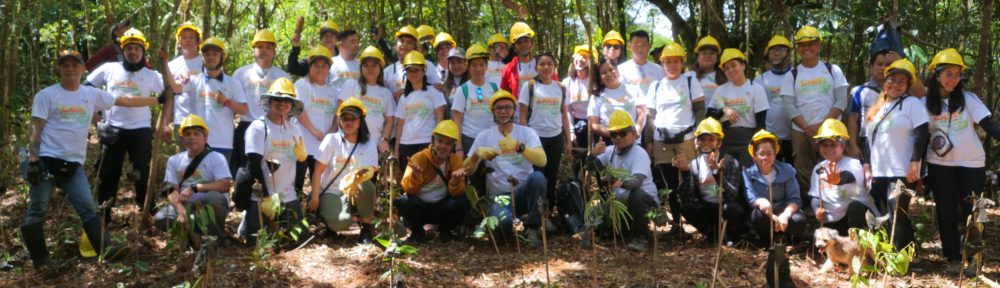
 03 June 2026, Laguna Quezon Land Grant, Siniloan, Laguna – Sierra Madre Mountain Range. As businesses continue to embrace environmental responsibility, meaningful partnerships are proving that sustainability is achieved through collective action.
Back in March 2026, Clarvida Philippines requested FEED to plant 100 native Philippine forest trees on the company’s behalf, to recognise the Philippine Board of Investments (BOI) compliance ruling, which requires all BOI-registered enterprises to plant a minimum of 100 forest trees or seedlings within one year from their official registration date.
Clarvida Philippines proudly marks another significant milestone by fulfilling its Board of Investments (BOI) tree planting compliance through the dedicated implementation of FEED and its longest LIVING LEGACY partner UPLB.
This mandatory environmental condition is governed by BOI Memorandum Circular (MC) No. 1, Series of 1999. Failure to comply or submit proof can result in the suspension, rejection, or revocation of tax credits and other registered fiscal incentives.
BOI Core Compliance Requirements
- The Quota: A minimum of 100 trees or seedlings per registered project.
- Timeline: Planting must be executed, and documentation submitted, not later than one year from the BOI certificate of registration date.
- Spacings & Species: Under MC No. 1, forest trees (such as Narra, Philippine Mahogany, and Acacia) are highly preferred. They should ideally be planted in clusters at least 4 meters apart, or along property perimeters spaced 2 to 4 meters apart.
- Location Flexibility: If your registered facility lacks physical ground space for perimeter planting, the BOI allows you to plant the trees in a public park or critical watershed of your choice, provided your firm remains responsible for their care and growth maintenance.
More than meeting a regulatory requirement, this initiative reflects Clarvida Philippines’ commitment to creating lasting environmental impact, supporting healthier ecosystems, and contributing to a greener future for the communities it serves. Together, this collaboration demonstrates that responsible growth and environmental stewardship can go hand in hand, leaving a legacy that extends well beyond today’s accomplishments.
CLARVIDA 100 TREES BOI COMPLIANCE PLANTING
- Date Planted: 03 June 2026
- Species:
- Malaruhat – 20
- Balayong – 20
- Bani – 20
- Igang – 10
- Katmon – 10
- Kupang – 10
- Marang – 10
Planted by forest guardians Randy Velina, Roger Glipo, Joel Velina and Teofilo Breganza.
 The successful fulfilment of Clarvida Philippines’ BOI tree planting commitment through FEED stands as a testament to what can be achieved when organizations unite around a shared purpose. As these trees take root and flourish, they symbolize not only compliance but also hope, resilience, and a long-term investment in the environment and future generations. Clarvida Philippines remains steadfast in its commitment to sustainability, recognizing that every tree planted today helps build stronger communities and a healthier planet for tomorrow.
Thank you Clarvida Philippine team, may the forest be with you always!
GPS Coordinates of CLARVIDA PHILIPPINES Planting Site
Use any GPS (Global Positioning System) software / applications to input the latitude and longitude coordinates to be able to remotely see the location of your trees planted. Some examples include:
https://www.gps-coordinates.net/
https://gps-coordinates.org
https://www.maps.ie/coordinates

PHOTO GALLERY OF PLANTING CLARVIDA FOREST IN SIERRA MADRES


ABOUT CLARVIDA PHILIPPINES
Clarvida Philippines (officially Clarvida Global Business Center) is the global shared services hub for Clarvida, a major US-based provider of behavioral and mental healthcare services. Established to streamline operations, the Manila branch handles finance, IT, marketing, human resources, legal, and compliance.
Core Functions: Operations and administrative support for clinical teams across the United States.
Why Ridge-to-REEForestation Matters in the Philippines
Ridge-to-REEForestation (R2R) is a smart and science-backed approach to restoring Philippine landscapes, from upland ridges down to rivers and coastal areas. By planting trees on steep slopes and connecting them with lower-elevation forests, this method helps prevent soil erosion, landslides, and sediment buildup in rivers, protecting both communities and ecosystems downstream. Continuous forest cover also provides vital habitats for endangered species, strengthens biodiversity, and enhances the land’s natural resilience to climate change. Beyond ecological benefits, R2R supports local livelihoods through community participation in planting and nursery work, ensuring that restoration efforts are sustainable in the long term. In a country facing deforestation and land degradation, Ridge-to-REEForestation offers a practical, multi-benefit strategy for healthier ecosystems, safer communities, and a greener future.
References:
- Lasco, R.D., Pulhin, F.B., & Cruz, R.V. (2008). Climate change and forest ecosystems in the Philippines: Vulnerability and adaptation. Philippine Journal of Science, 137(1), 77–90.
- Pulhin, F.B., Lasco, R.D., & Inoue, M. (2019). Forest landscape restoration in the Philippines: Approaches, challenges, and opportunities. Forests, 10(9), 770.
- Food and Agriculture Organization (FAO). (2020). Forest and landscape restoration for sustainable development in Asia and the Pacific. FAO Regional Office for Asia and the Pacific.
Why the Sierra Madre Mountain Range is critically important:
1. The Sierra Madre is the Philippines’ Last Great Natural Shield – The “Backbone of Luzon” protects millions of lives.
- The Sierra Madre mountain range absorbs and weakens typhoons before they reach Metro Manila and Central Luzon. Without its forested slopes, storms hit lowland communities with full, catastrophic force. Forests act as windbreaks, reducing wind speed.
- Tree roots hold soil, preventing deadly landslides.
- Upland forests regulate river systems, preventing flash floods downstream (Cagayan, Isabela, Bulacan, Rizal, NCR).
- Reforesting the Sierra Madre literally strengthens the natural shield that protects Luzon’s densest population centers.
2. The Philippines Has One of the Highest Biodiversity Levels on Earth — and One of the Highest Rates of Loss
- The Philippines is one of 17 megadiverse nations. It has over 52,000 species, many found nowhere else. But over 90% of original primary forests have been lost due to logging, agriculture, mining, and urbanization.
- This means every remaining forest — especially the Sierra Madre — is a refuge for species that could disappear forever.
- Planting native trees restores: Habitat for endangered species; Migration corridors; Gene pools essential for future climate adaptation; Balance in ecosystems that regulate water, soil, and pollinators.
- Restoring natural forests is equivalent to preserving the biological soul of the Philippines.
3. With the 5th Longest Coastline in the World, Filipinos Depend on Both Upland and Coastal Forests
- The Philippines’ coastline is longer than that of many larger countries, and this creates both beauty and vulnerability.
- Coastal forests & mangroves:
– Protect communities from storm surges
– Reduce coastal erosion
– Support fish nurseries, essential to fisheries that feed the nation
– Sequester carbon up to 4–5× faster than terrestrial trees - Upland forests (like the Sierra Madre):
– Regulate water flow to coastal areas
– Prevent sedimentation that smothers mangroves, coral reefs, and fisheries
– Maintain aquifers that supply drinking water to coastal cities - Reforesting uplands is deeply connected to protecting coasts — the systems are interdependent.
4. Climate Change Hits the Philippines First and Hardest
- The Philippines is:
– Top 3 globally in climate risk vulnerability
– Struck by 20+ typhoons annually
– Experiencing hotter, longer dry seasons and more severe rainfall cycles - Trees help stabilize climate by:
– Cooling local temperatures
– Increasing rainfall predictability
– Storing carbon
– Creating microclimates that support agriculture - The Sierra Madre forests are a key part of the Philippines’ climate adaptation strategy.
5. Forests Keep Rivers Alive — and the Philippines Runs on Watersheds
- The Sierra Madre feeds major rivers such as: Cagayan River, Kaliwa River and Angat Watershed (critical for Metro Manila’s water supply).
- Trees:
– Increase water infiltration
– Reduce siltation in dams
– Recharge aquifers
– Ensure stable, long-term water supply - Without forests, rivers die — and so do the cities and farms that depend on them.
6. Forests Support Rural Livelihoods and Indigenous Communities
- Reforestation:
– Provides employment
– Strengthens local stewardship of forests
– Revitalizes Indigenous cultural landscapes
– Supports ecotourism and sustainable resource use
– Healthy forests uplift communities who act as guardians of the land.
7. Restoring Lost Forest Cover = Rebuilding the Earth’s Life-Support System
- The Philippines has lost over 9 million hectares of forests in the last century, with many areas becoming dangerously degraded.
- Restoring these forests:
– Prevents desertification
– Rebuilds soil health
– Revives pollinators
– Reconnects fragmented habitats
– Restores the natural cycle of carbon, water, and life - It is essential for the country’s ecological and economic future.
 In summary: Why is planting in the Sierra Madre and the Philippines so important?
Because trees in these landscapes:
- Save lives
- Protect cities
- Preserve biodiversity
- Secure food and water
- Limit climate disasters
- Strengthen coastlines
- Rebuild ecosystems
- Support Indigenous and rural livelihoods
Planting trees in the Sierra Madre — and across our archipelago — is an investment in the long-term survival and resilience of the Philippines.
Tree-Nurturing Program with FEED
Immerse yourself in nature and explore our Tree-Nurturing Program in Siniloan, Laguna, nestled within the Sierra Madre Mountain Ranges. Witness the untouched beauty of Mother Nature—watch this video for a glimpse of a tree-planting experience with FEED and its partner local communities.

Direct Link: https://www.youtube.com/watch?v=wFb2_0qr93g
Contact info@feed.org.ph or call +63 (0)917 552 4722 to carry out your tree planting today!
(c) Fostering Education and Environment for Development, Inc.