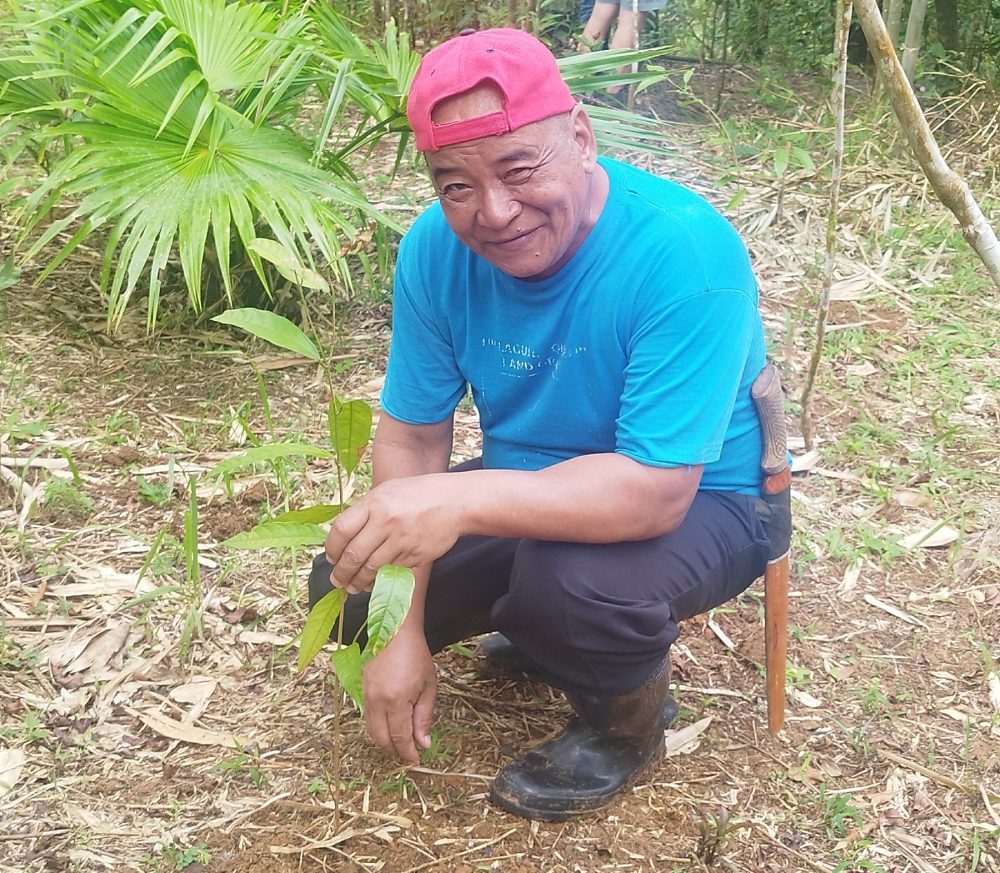
 13 February 2026, Laguna Quezon Land Grant, Siniloan, Laguna. Demonstrating that collective action can start with a single thoughtful gesture, Marga “Ata” Roxas led a personal reforestation initiative at the UP Laguna-Quezon Land Grant (LQLG) today, planting 30 native trees on behalf of her 10 colleagues, gifting each of them with 3 trees.
The activity involved FEED partners trekking to the LQLG reforestation site – an over 9,000 hectare protected reserve within the Sierra Madre mountain range to prepare the site and plant the right species. The 30 trees represent a symbolic and tangible gift for her ten workmates, extending her personal commitment to environmental sustainability to her professional circle.
“Every individual action contributes to the health of our planet, but when you plant for others, you inspire a ripple effect,” said Marga “Ata” Roxas. “I wanted to give my colleagues the gift of a greener future—something that will last far longer than any material present. This is for them, and for the next generation that will benefit from a stronger Sierra Madre.”
The UP Laguna-Quezon Land Grant is a critical component of the Sierra Madre mountain range, often hailed as the “backbone of Luzon.” It serves as the country’s natural barrier against powerful typhoons coming from the Pacific. FEED has been working since its 2011 contract with UPLB to rehabilitate the area through community-based forestry management, ensuring that reforestation efforts provide both ecological security for lowland communities and livelihood opportunities for local forest guardians.
“We are always heartened when individuals like Marga choose to celebrate their personal and professional relationships through the legacy of a tree,” said Anne-Marie Mananquil Bakker, Partnerships Director at FEED. “By planting 30 trees for her 10 colleagues, she is not just offsetting carbon footprints; she is literally rooting their shared bond in the conservation of the Sierra Madre. It is a beautiful example of how reforestation can be a personal and meaningful act.”
 The seedlings planted are native species, carefully selected to ensure they bolster the local biodiversity and enhance the forest’s resilience against climate change. The trees will be maintained and monitored by FEED and local forest protection officers to ensure a high survival rate.
- No. of Trees: Igang 20 Narra 10 Total 30
- Community Planters: Vincent Ivan M. Donato Leody A. Avenido Elmer B. Dayandante
This initiative adds to the growing momentum of corporate and individual partnerships supporting the rehabilitation of the Sierra Madres, contributing to a safer, greener, and more sustainable future for the Philippines.
Photo Gallery


GPS Coordinates

Why 30 Trees Gifted by One Person Matters
- The Sierra Madre Is the Philippines’ Natural Shield
The Sierra Madre is the country’s longest mountain range and serves as a natural typhoon barrier for Luzon. When forests are intact:
- Wind speeds are reduced
- Flooding is less severe
- Landslides decrease
- Water systems stay stable
- When forests are degraded, communities downstream suffer.
- Planting 30 trees contributes to strengthening that shield.
2. Trees Multiply Their Impact Over Time
One native tree can:
- Absorb 20+ kg of CO₂ per year
- Support birds, insects, and soil life
- Improve groundwater recharge
- Provide future livelihood (if part of agroforestry systems)
Thirty trees today can become:
- A mini-forest pocket
- Habitat for biodiversity
- A seed source for future regeneration
Restoration works through accumulation — small acts compound.
3. Collective Action Scales Exponentially
If one person plants 30 trees for colleagues:
10 people = 300 trees
100 people = 3,000 trees
1,000 people = 30,000 trees
The Sierra Madre spans provinces — restoration requires distributed action. One person’s initiative can catalyze many.
4. It Connects Urban People to Rural Forest Communities
For regions like the Sierra Madre:
- Local upland communities often manage nurseries and plant sites
- Tree planting programs create livelihood
- It shifts funding toward long-term stewardship
Planting trees “on behalf of colleagues” builds bridges between offices and forests, cities and uplands.
5. It’s Not Just About Climate — It’s About Water and Food Security
The Sierra Madre feeds major river systems that irrigate farms and supply water to millions in Luzon. Restoring forests:
Stabilizes watersheds
Protects agriculture
Reduces disaster risk
This is national resilience, not just environmental symbolism.
Why This Matters Anywhere — Not Just the Philippines
Even outside the Sierra Madre:
- Forests regulate rainfall patterns
- Trees cool cities and reduce heat stress
- Biodiversity restoration strengthens ecosystems
- Climate mitigation requires distributed participation
- Tree planting becomes meaningful when:
- Native species are used
- Survival and maintenance are ensured
- Communities are involved
The Deeper Reason
Planting 30 trees is not just an ecological act — it’s a statement of responsibility.
It says: “I benefit from this planet. I will contribute to its repair.” In large-scale environmental restoration, momentum begins with individuals choosing to act — even in small numbers.
About FEED
FEED (Fostering Education & Environment for Development), Inc. is a non-profit organization based in the Philippines that designs and implements sustainable development programs through reforestation, renewable energy, and education. FEED works with partners to protect and restore critical ecosystems like the Sierra Madre while empowering local communities.
Tree-Nurturing Program with FEED
Immerse yourself in nature and explore our Tree-Nurturing Program in Siniloan, Laguna, nestled within the Sierra Madre Mountain Ranges. Witness the untouched beauty of Mother Nature—watch this video for a glimpse of the experience.
Contact info@feed.org.ph or call +63 (0)917 552 4722 to carry out your tree planting today!
(c) Fostering Education and Environment for Development, Inc.