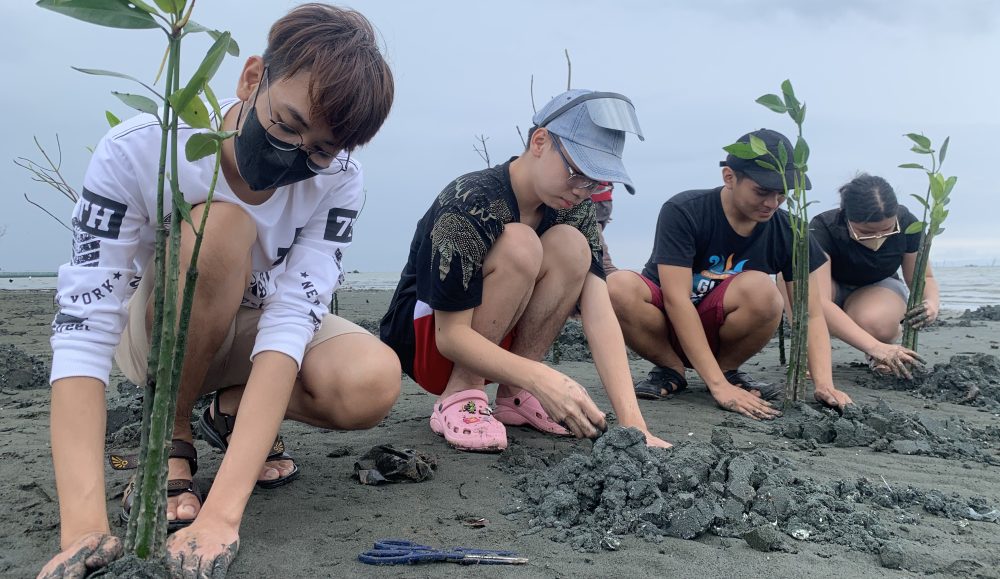
 Laguna, Philippines – June 20, 2025. Under the heavy gray skies of the Sierra Madre, the air was thick with both moisture and meaning. A light drizzle swept across the Laguna Quezon Land Grant, but the spirits of those gathered remained undampened. This wasn’t just another tree-planting activity—it was a reawakening. A powerful reminder that healing the land must go hand in hand with empowering the people who call it home.


 More than 150 volunteers from Open Text Philippines came together with FEED, Inc., local residents, and Forest Guardians to plant 1,980 native Philippine trees—a blend of Malaruhat, Palong Maria, Kupang, and Apitong.These species were carefully selected not only for their ecological significance but also for their ability to survive and thrive in local conditions, providing long-term benefits to biodiversity, climate resilience, and the livelihoods that depend on them.


 The effort was part of the larger Ridge to Reef strategy, a visionary ecological approach that links upland forest restoration to the protection of coastal ecosystems. When forests thrive, they prevent erosion, stabilize rivers, and maintain the flow of clean water to lowland farms, fishing grounds, and coastal reefs. The health of these interconnected ecosystems directly influences food security, disaster resilience, and even national development.


 But in many parts of the country, this natural balance has been eroded—literally and figuratively—by decades of neglect, unsustainable resource use, and systemic poverty. Communities that live closest to forests are often blamed for illegal logging, but rarely are the root causes addressed.
Illegal logging is a visible scar on the landscape, but it is often a desperate response to invisible pressures. In areas where economic opportunities are scarce, forests become both a refuge and a last resort. Cutting trees illegally isn’t usually done out of greed—it’s often a matter of survival. When there are no jobs, no access to markets, and no support for alternative livelihoods, the forest becomes collateral damage.


 To truly protect the forest, we must first protect the people. And this event at the Laguna Quezon Land Grant is a step in that direction—not just by planting trees, but by planting the seeds of collaboration, dignity, and shared responsibility.

 A critical component of this initiative lies in strengthening community-based livelihoods that work with nature, not against it. Women from the surrounding barangays prepared meals for the volunteers—nourishing, locally sourced dishes that reflect both cultural pride and economic opportunity. Meanwhile, Forest Guardians led the planting with expert knowledge passed down over generations, proving that conservation is not just science—it is also heritage.


 To deepen its commitment, Open Text Philippines also provided in-kind donations to the local community—supplies and goods carefully selected to meet practical needs and support daily life in the upland barangays. This gesture, while modest in scale, symbolized solidarity and respect: a recognition that true environmental stewardship includes supporting the people who live closest to the land. There is an urgent need to scale up support for sustainable enterprises such as agroforestry, ecotourism, forest-based crafts, native seedling nurseries, and regenerative farming. These are not charity projects; they are practical, scalable solutions that offer families consistent income without harming the environment. Real, dignified work can make illegal logging obsolete—not by policing it, but by making it irrelevant.

 What made this day truly remarkable wasn’t just the number of trees planted, but the diversity of people who came together—from corporate professionals to community elders, from youth volunteers to seasoned foresters. In a country fragmented by economic and geographic divides, events like these build something more enduring than any single seedling: solidarity. The climate crisis may be global, but its solutions are often local. They are found in muddy boots, in laughter shared over hot meals, in the quiet determination of those who plant not for today, but for generations to come. They are found in the courage to say: we can do better—together.
As the country approaches the rainy season, each downpour will help root the newly planted seedlings deeper into the earth. But the real challenge lies ahead: ensuring that these efforts are not one-time gestures, but sustained commitments. Protecting the forest is not just an environmental task—it is a social, economic, and moral imperative.
To restore our forests, we must restore justice and opportunity to those who live with them. That is how we build resilience—not just ecological, but national.
 Let this be our collective story: not of loss, but of renewal. Not of blame, but of partnership. One tree, one livelihood, one act of hope at a time.
Photo Library:


GPS Coordinates & Photos of Planting Site
Use any GPS (Global Positioning System) software / applications to input the latitude and longitude coordinates to be able to remotely see the location of your trees planted. Some examples include:
- https://www.gps-coordinates.net/
- https://gps-coordinates.org
- https://www.maps.ie/coordinates.htmlhttp://www.mapcoordinates.net/en

Tree-Nurturing Program with FEED
Immerse yourself in nature and explore our Tree-Nurturing Program in Siniloan, Laguna, nestled within the Sierra Madre Mountain Ranges. Witness the untouched beauty of Mother Nature—watch this video for a glimpse of the experience.