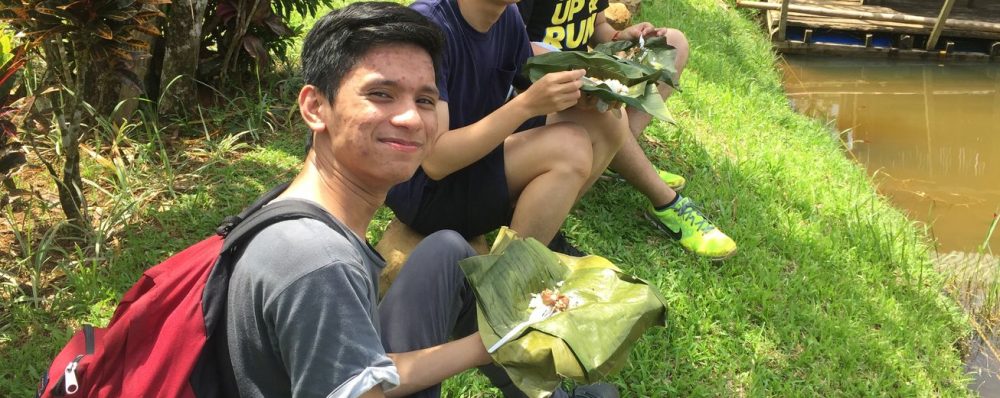
 02 Mar 2024, Siniloan, Laguna, Sierra Madre Mountain Range. 135 super enthusiastic Ecowarrrors from Avaloq Philippines Operating Headquarters today demonstrated their commitment to environmental preservation and community development by sponsoring their active participation in a tree planting event at the UP Sierra Madre Land Grants in Sinloan, Laguna.

 It was a family and friends day for the staff, who were invited by Avaloq to bring their plus ones (partners, friends, family) to join, all the more inspiring to see the children of various ages getting as excited about the trek and planting as the adults.
 200 native philippine upland forestry species were planted, namely kalumpit (Batangas cherry tree), bani , and malaruhat; each providing its own contribution towards biodiversity and ecosystem preservation of the Sierra Madre Mountain Range, the main buttress against the annual average 12 typhoons that strike the country typically originating from the South East; not to mention the food security provided to not only human beings but also all other forest propagators in particular, such as bees, bats and birds.


Kalumpit
- Source of nectar for insects and birds.
- Studies have suggested anti-inflammatory, cytotoxic, anticancer, larvicidal, antioxidant properties.
- Source: www.stuartxchange.org/Kalumpit.html
 Bani
Bani
- In Ayurveda and Unani medicine, used as anti-inflammatory, anti-plasmodial, anti-noniceptive, antihyperglycemic, anti-lipidoxidative, anti-diarrheal, anti-ulcer, anti-hyperammonic and antioxidant.
- Studies have suggested antibacterial, antioxidant, hypolipidemic, hypoglycemic, anti-lice, anti-lipide peroxidative, gastroprotective, anticonvulsant, anti-hyperammonemia, antipyretic, hepatoprotective, cardioprotective, anti-psoriatic, nephroprotective, phytoremediative properties.
- Source: www.stuartxchange.org/Bani.html
 Malaruhat
- Studies have suggested anticancer, antigout, antioxidant, antidiabetic, anti-inflammatory properties.
- Source: www.stuartxchange.com/Malaruhat
Planting Trek and Morning Program
 Avaloq participants experienced a short welcome talk in the early morning, followed up a short warm up to get the heart rate going (since some staff came straight from their night shift), a 30 minute easy trail to their planting site, and the planting itself, which was relatively fast – given that the forest guards had already prepared the standard holes and spacing, bamboo stake markers and seedlings situated per hole.
 Other Avaloq staff decided that the experience up to planting was too “bitin” or short, so about 35 proceeded to trek up to the first top ridge, about 1300 feet from sea level, in order to experience the view of standing amidst 40 such mountain ranges en route to Quezon Province via our national Infanta Road route.
 They were very brave, since it took them another 2 hours and 2.5 kms journey before being able to return to base camp to enjoy the native bilanot chicken adobo meal of portions suitable for forest guards! Congratulations Avaloq Philippines!
 We are grateful to you all for your 111 percent commitment to environmental and community restoration, as part of our joint efforts to ensure the Philippines water and food security!

 Photo Journal & GPS Coordinates


About Avaloq Philippines Operating Headquarters
 Avaloq is an industry-leading provider of wealth management technology and services for financial institutions around the world, including private banks and wealth managers, investment managers, as well as retail and neo banks. We are the only independent provider of digital banking solutions to both develop and operate its own software through cloud-based Software as a Service (SaaS) or on-premises models.
Fore more details, visit: https://www.avaloq.com/about-us/sustainability
On Carbon Sequestration – How Much CO2 can our trees absorb?
Trees are often referred to as the “lungs of the Earth” as they are able to store carbon and produce oxygen, which is essential to many life forms. Trees also stabilise soil and reduce air temperature and humidity, whilst also reducing flooding and improving water quality. Without trees, most fauna and flora would not survive, what more humans?
It is widely accepted that a typical tree can absorb around 22 kilograms of carbon dioxide (CO2) per year when in fully grown status, meaning that saplings, seedlings and younger trees – whether mangroves or primary or secondary forest trees – absorb around half, so conservatively say 11 kgs per year (also widely used by most international forestry agencies around the world).

So, over a lifetime of a tropical tree (100 years), one tree can absorb around 1 tonne of CO2. Although this figure seems large, it should be measured in perspective: to date we humans generate around 40 billions tonnes of CO2 each year on Earth. Which means, that we need to plant 40 billion trees annually to offset these emissions.
NATURE IS SPEAKING (Narrated by Julia Roberts)

What can I do to stop climate change?
“As the world warms, extreme weather events are becoming more frequent and intense, sea levels are rising, prolonged droughts are putting pressure on food crops, and many animal and plant species are being driven to extinction. It’s hard to imagine what we as individuals can do to resolve a problem of this scale and severity.
The good news: We are not alone. People, communities, cities, businesses, schools, faith groups and other organizations are taking action. We’re fighting like our lives depend on it — because they do.
In a world of more than seven billion people, each of us is a drop in the bucket. But with enough drops, we can fill any bucket.” – David Suzuki
Check out some of the ways you can take more climate change action.
For example, Climate Action groups are the local solution to a global crisis. Right now people just like you are coming together to develop practical, local solutions and make their towns and cities more climate-friendly. Are you ready to join them? Find out what’s happening near you.
More here: https://friendsoftheearth.uk/climate-change/what-can-I-do-to-stop-climate-change


Contact FEED
In 2015, the Philippine government submitted to the United Nations the country’s commitments to reduce greenhouse gas emissions. The country committed to reduce its carbon emissions by 70 percent by 2030. The carbon dioxide reductions will come from the sectors of energy, transport, waste, forestry and industry. Join us! Help us reverse the Earth’s “hothouse climate” tipping point.

Tree-Planting with FEED
Contact us at FEED for more details, to join our regular activities or to design your own tree-nurturing event: info@feed.org.ph or call/text +63 (0)917 552 4722.
© Fostering Education & Environment for Development, Inc.