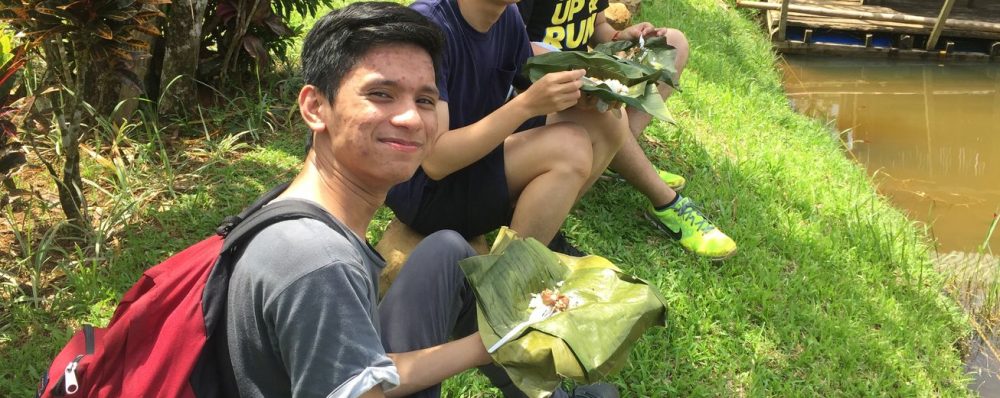
 30 July 2022, Siniloan, Laguna – Sierra Madre Mountain Range. Thank you to the 22 staunch ecowarriors at the Philippine Stock Exchange (PSE) for once again taking climate action through tree planting, helping several communities in Barangay Maunlad, Kapatalan and surrounding villages in the Sierra Madres to restore its original habitat.
 Native species planted include 90 malaruhat puti, 50 malasantol pula, 50 bani and 50 white lauaan, for a total of 240 trees added to the over 9,000 hectares protected forest managed by FEED’s longest Living Legacy partner the University of the Philippines Los Baños (UPLB).

- Sustainability Innovation Lab Add 186 Trees to Sierra Madres (20 Nov 2023)
- Philippine Stock Exchange Takes Climate Action Planting 240 Trees in Sierra Madres (21 Oct 2023)
- GRI, SEC & PSE Add 240 Trees to Their Sierra Madre Forest, Commemorating 9th GRI-SEC Corporate Governance Forum (10 Nov 2022)
- SEC, GRI & PSE Fortify their Sierra Madre Forest with 264 More Trees (20 Nov 2021)
- Global Reporting Initiative, Securities & Exchange Commission and Philippine Stock Exchange Gift a Forest to Friends (13 Nov 2020)
- Earth Keepers from Financial Sector Sponsor Their Own Forest (09 Dec 2020)
Status of Forests & Philippine Forests
Planting trees is acknowledged as one of the most effective ways to lower carbon dioxide (CO2) levels and limit global warming. Forests remove CO2 by natural photosynthesis, which stores carbon in their roots, soil and structure, as a fundamental influence in the hydrological cycle. Plants and trees use water, sunlight and carbon dioxide to in turn produce oxygen and glucose, while the water sourced from the ground is taken into the plants through its root system.
Countries around the work are adopting such nature-based solutions to tackle man-made industrial emissions. Though deforestation losses worldwide still outweigh planting and reforestation gains, consolidated efforts by private and public sector organisations, including NGOs are scaling up efforts to catch up.
Knowing that the Philippines ranks top 3 around the world in biodiversity of flora and fauna, and that 80 percent of the world’s known terrestrial plant and animal species are found in forests, makes our joint efforts all the more important in regenerating these Ridge to Reef ecosystems for healthier wildlife and plants to thrive.
“Research by ETH Zurich shows that there is room to plant an additional one trillion trees on Earth. Some 900 million hectares (2.2 billion acres) of land is currently unused by humans worldwide – similar in size to the land area of the US – that could be forest, storing 205 gigatons (billion metric tonnes) of carbon once the trees mature in 50-100 years.”
Source: https://www.discovery.com/science/melting-glaciers-could-flood-society-with-problems
In the Philippines, the top 11 regions were responsible for 52% of all tree cover loss between 2001 and 2022. Palawan had the most tree cover loss at 202 thousand hectares (kha) compared to an average of 17.6 kha.
1 Palawan 202 kha
2 Agusan del Sur 125 kha
3 Zamboanga del Norte 64.3 kha
4 Davao Oriental 53.4 kha
5 Quezon 46.4 kha
6 Apayao 43.6 kha
7 Surigao del Sur 43.6 kha
8 Cagayan 43.0 kha
9 Compostela Valley 41.7 kha
10 Samar 38.4 kha

Source: Global Forest Watch 2024 (https://www.globalforestwatch.org/dashboards/country/PHL/)

Source: Global Forest Watch 2024 (https://www.globalforestwatch.org/dashboards/country/PHL/)
Picture Gallery


About The Philippine Stock Exchange (PSE)
 The Philippine Stock Exchange, Inc. (PSE) is a self-regulatory organization that provides and ensures a fair, efficient, transparent and orderly market for the buying and selling of securities. The Exchange also offers a convenient and efficient venue in raising capital to support the growth of businesses.
Considered one of the oldest bourses in Asia, the PSE traces its roots back to the country’s two former bourses – the Manila Stock Exchange (formed in 1927) and the Makati Stock Exchange (formed in 1963). The Manila and Makati bourses were unified on December 23, 1992 to form the PSE.
In 2018, the PSE moved its headquarters to Bonifacio Global City (BGC) in Taguig. The fast paced environment in the Taguig business district is well-suited for the Exchange as it aims to fast track the introduction of new products and services to boost investor participation and liquidity in the Philippine stock market.
For more on PSE, visit: https://corporate.pse.com.ph
What can I do to stop climate change?
“As the world warms, extreme weather events are becoming more frequent and intense, sea levels are rising, prolonged droughts are putting pressure on food crops, and many animal and plant species are being driven to extinction. It’s hard to imagine what we as individuals can do to resolve a problem of this scale and severity.
The good news: We are not alone. People, communities, cities, businesses, schools, faith groups and other organizations are taking action. We’re fighting like our lives depend on it — because they do.
In a world of more than seven billion people, each of us is a drop in the bucket. But with enough drops, we can fill any bucket.” – David Suzuki
Check out some of the ways you can take more climate change action.
For example, Climate Action groups are the local solution to a global crisis. Right now people just like you are coming together to develop practical, local solutions and make their towns and cities more climate-friendly. Are you ready to join them? Find out what’s happening near you.
More here: https://friendsoftheearth.uk/climate-change/what-can-I-do-to-stop-climate-change

Contact FEED
In 2015, the Philippine government submitted to the United Nations the country’s commitments to reduce greenhouse gas emissions. The country committed to reduce its carbon emissions by 70 percent by 2030. The carbon dioxide reductions will come from the sectors of energy, transport, waste, forestry and industry. Join us! Help us reverse the Earth’s “hothouse climate” tipping point.

Tree-Planting with FEED
Contact us at FEED for more details, to join our regular activities or to design your own tree-nurturing event: info@feed.org.ph or call/text +63 (0)917 552 4722.
© Fostering Education & Environment for Development, Inc.