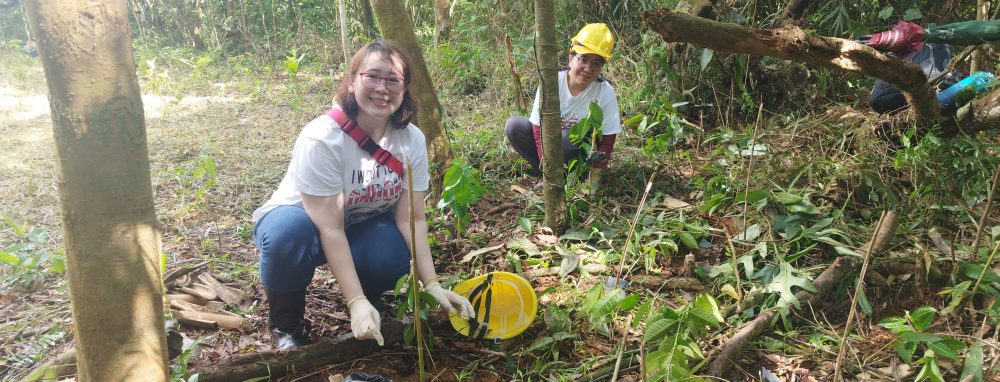
 Laguna, Philippines – May 17, 2025 — As the incoming rains began to soften the dry season, the Laguna Quezon Land Grant buzzed with a revitalized sense of purpose. Beneath a day of bright sun and sudden gentle showers—a characteristic of the Sierra Madre’s microclimate—a transformative initiative was underway: the planting of life, hope, and resilience. The event was set in motion by a dedicated team of volunteers from the Japan Research Institute Limited, Philippines branch, whose mission was to plant 100 native Philippine trees. This effort comprised 50 Malaruhat and 50 Kupang trees—species chosen not only for their deep roots in the country’s ecological heritage but also for their proven ability to thrive locally, symbolizing both a homage to tradition and a concrete step toward sustainability.


 The morning opened with a burst of energy as Rose Bocado of the Laguna Quezon Land Grant led the group through warm-up exercises, a ritual that blended physical readiness with communal spirit. A brief introduction was given by Forester Rey Lorida and he discussed the Ridge to Reef program—a visionary strategy that links the fate of upland forests to the health of coastal and marine ecosystems. Everyone has the same goal forday’s task in a broader narrative: one where every tree planted upland helps protect lives and livelihoods downstream.
 The Ridge to Reef approach embodies this philosophy. Beyond tree planting, it seeks to restore mangroves along the coasts and breathe life back into coral reefs—recognizing that ecosystems are not isolated, but deeply connected. What happens in the highlands affects the rivers, the bays, and the lives that depend on them all. By embracing this holistic model, FEED, Inc. and its partners are not just reforesting a mountainside; they are stitching together the fabric of a more resilient future.


 As the group began their planting, each seedling placed into the earth carried with it more than roots—it carried intention. The Malaruhat and Kupang, both essential to the region’s biodiversity, were more than mere flora; they were pledges to the land. These native trees, with their intricate root systems and natural resilience, hold the power to prevent erosion, enrich the soil, cool the air, and nourish native wildlife. They stand as natural fortresses against the worsening threat of climate change, quietly absorbing carbon and storing it in their growing trunks and branches.

 But trees alone cannot restore a forest. What breathes life into an initiative like this is community. Residents from nearby villages, many of whom have lived in harmony with this landscape for generations, played vital roles. Women from the community lovingly prepared meals that nourished every participant, their food an offering of gratitude and solidarity. Forest Guardians, led by Forester Rey Lorida, brought with them a deep understanding of the land, ensuring every seedling found a place where it could thrive.
 Throughout the day, the work was demanding but fulfilling. Mud-caked hands, shared laughter, and quiet determination painted a picture of what true environmental action looks like: collaborative, grounded, and deeply human.
Perhaps the most profound lesson of the day was this: when people come together—whether from research institutes, grassroots communities, or conservation organizations—change takes root. Shared action multiplies impact. It builds bridges across disciplines, geographies, and cultures. And in the face of a climate crisis that too often feels insurmountable, it reminds us that progress is possible—one tree, one effort, one partnership at a time.

 This event stands as a testament to what can be achieved when vision meets action. The unwavering dedication of the Japan Research Institute Limited, Philippines branch; the wisdom and commitment of local communities; and the leadership of FEED, Inc. formed a powerful alliance for nature. And while the newly planted seedlings are still small, they are symbols of something much greater: a future rooted in care, cooperation, and courage.
As the rains begin to fall more steadily in the weeks ahead, nurturing each newly planted tree, the call goes out to others: join us. Be part of this journey to restore, to protect, and to grow a greener, more resilient Philippines—tree by tree, step by step, story by story.
Photo Library:


GPS Coordinates & Photos of Planting Site
Use any GPS (Global Positioning System) software / applications to input the latitude and longitude coordinates to be able to remotely see the location of your trees planted. Some examples include:
- https://www.gps-coordinates.net/
- https://gps-coordinates.org
- https://www.maps.ie/coordinates.htmlhttp://www.mapcoordinates.net/en

Tree-Nurturing Program with FEED
Immerse yourself in nature and explore our Tree-Nurturing Program in Siniloan, Laguna, nestled within the Sierra Madre Mountain Ranges. Witness the untouched beauty of Mother Nature—watch this video for a glimpse of the experience.